
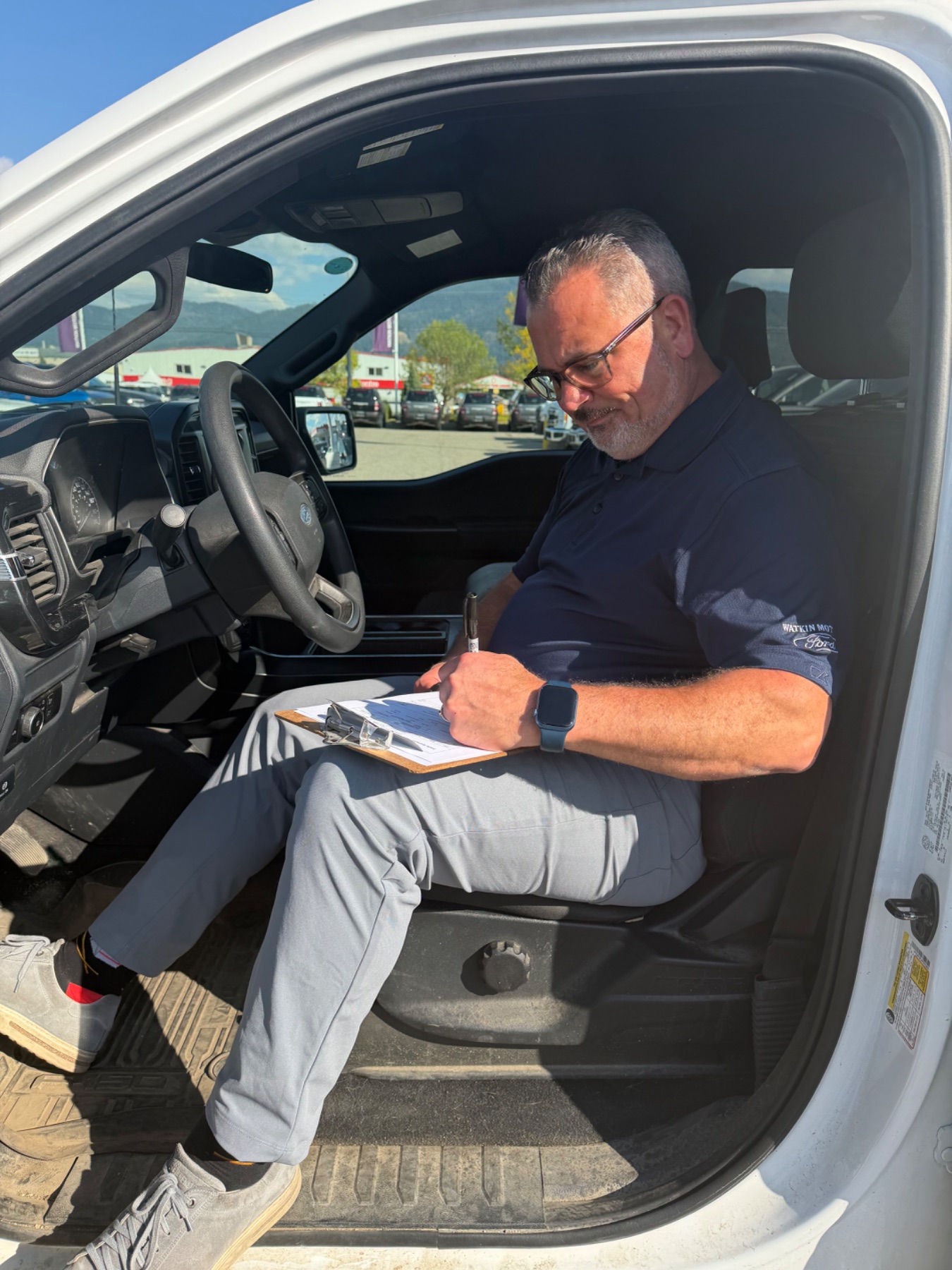
What’s my car worth in Vernon? It is worth what a buyer will pay for it this month, and that number is set by six things: the year, make, model and trim; the kilometres; the condition; the accident and claims history; the equipment on it; and what Okanagan buyers are looking for right now. The fastest way to get a real figure is a free appraisal at Watkin Motors Ford. You do not have to buy a vehicle from us to sell us yours.
This guide explains how a trade-in value is set in B.C., what the Canadian used market is doing to that value in 2026, and the tax rules that decide whether trading in or selling privately leaves more money in your pocket. Every figure comes from a named source, listed at the end.
SELL OR TRADE YOUR VEHICLE IN VERNON
Get a written offer on your car, truck or SUV, whether or not you buy from us.
Tell us the year, make, model, trim and kilometres. We confirm within one business day, then inspect the vehicle at 4602 27th Street and put a number in writing.
$39,427
Average used-vehicle listing price in British Columbia, June 2026. The highest of any region in Canada (AutoTrader Price Index).
12%
PST plus GST you do not pay on the trade-in portion when you trade at a B.C. dealer on a vehicle priced under $55,000.
48.6%
Share of Canadian franchised dealers who said finding used stock got harder in the first half of 2026 (DesRosiers and UCDA survey).
What’s my car worth in Vernon? Three numbers, and which one applies
When people ask what their car is worth in Vernon, they usually get three different answers, and all three are correct for a different buyer.
- Trade-in (wholesale) value. What a dealer pays to take the vehicle today, as is, and carry the cost of reconditioning, safety inspection, any lien payout and the weeks it sits before it sells. Canadian Black Book publishes this figure from Canadian dealer and auction transaction data, updated daily, and it is the number the B.C. government itself uses to assess tax on private sales.
- Private-sale value. What another person might pay you directly. It is usually above trade-in, but the gap is smaller than it looks once the B.C. private-sale tax rules below are applied, and you take on the paperwork, the test drives and the legal exposure yourself.
- Retail value. The price a dealer lists a reconditioned, inspected vehicle at, with the protections the Motor Dealer Act requires a licensed dealer to provide. This is never what a vehicle is worth to sell, only to buy.
A written appraisal from a dealer gives you the first number for your specific vehicle. Online tools such as the Canadian Black Book estimator give a range for your year, make, model, trim, postal code and odometer reading. The range is wide because nobody has seen the vehicle yet. The inspection is what turns the range into a figure.
What an appraiser in Vernon actually looks at
Canadian Black Book lists the inputs to a trade-in value as make and model, year, trim, mileage, condition, optional equipment and local market conditions. Here is how each one plays out on our lot.
- Year, make, model and trim. Trim matters more than most owners expect. An XLT and a Lariat with the same kilometres are two different vehicles at auction. Bring the window sticker or the original bill of sale if you have it.
- Kilometres. Ford’s own certified pre-owned program, Ford Blue Advantage, only accepts Ford models up to six years old with under 130,000 km for Gold certification and under 160,000 km for Blue, and each must pass a 172-point inspection. A vehicle inside those limits can be sold with a Ford-backed extended service plan, which is why the odometer moves the number as much as it does.
- Condition. Tires, brakes, glass, paint, interior wear, warning lights and anything that has to be fixed before the vehicle can pass a safety inspection. Each of those is a line on the reconditioning estimate, and the reconditioning estimate comes straight off the offer.
- Accident, claims and status history. The appraiser pulls a vehicle history report, and in B.C. the vehicle’s registration status is public: anyone can check whether a VIN is Normal, Rebuilt, Salvage or Altered on ICBC’s free lookup. A Rebuilt brand is permanent and the vehicle is valued accordingly.
- Service history. Stamped records or a Watkin service file showing oil changes, brake work and recall completion remove doubt, and doubt is what an appraiser prices in. If your vehicle was serviced at our service department, we already have the file.
- Equipment. 4×4 or AWD, tow packages, a second set of wheels with winter tires, running boards, a canopy or tonneau, a trailer brake controller. In the North Okanagan these are the things the next buyer asks about first.
- What the market wants this month. A dealer buys your vehicle to sell it, so the offer reflects what is selling. The next section covers where that stands in 2026.
The Vernon factor. Winter tires, or tires with the M+S marking, are required on most B.C. highways from October 1 to April 30, including the Coquihalla and the road up to Silver Star. A vehicle that arrives for appraisal with a mounted set of winter tires has just answered the first question every Okanagan used-vehicle buyer asks. Details are in our post on what B.C.’s winter tire law requires.
What the 2026 Canadian used-vehicle market is doing to your number
Three Canadian sources published in the last few months describe the same market from three angles: prices, supply and dealer demand.
- Prices are easing, and B.C. remains the most expensive region. The AutoTrader Price Index for the second quarter of 2026 puts the national average used-vehicle price at $36,690, down 2.6% year over year. British Columbia’s average was $39,427 in June 2026, down 5.6% from June 2025 but still the highest of any region in the country. Used days’ supply was 44 days, up from 41 a year earlier.
- Supply is still constrained, and will be until at least 2027. The same report attributes it to low new-vehicle production and sales from 2020 to 2023, which limits the number of off-lease vehicles coming back into the used market now. DesRosiers Automotive Consultants says the same thing about 2021 to 2024 new sales.
- Dealers are short of used stock and buying most of it from the public. In the DesRosiers and Used Car Dealers Association survey published in September 2026, 48.6% of franchised new-vehicle dealers said used-vehicle sourcing got worse in the first half of the year, and consumer sales, meaning trade-ins and direct purchases from owners, made up an average 67.7% of where franchised dealers got their used inventory.
- Values are forecast to keep falling through 2026, with light trucks holding up best. Canadian Black Book’s 2026 market preview forecasts used-vehicle depreciation of about 14.5% for the year, with most of the decline landing by April, and notes that crossovers, SUVs and trucks are expected to outpace passenger cars. It also flags a possible positive retention trend for domestically branded full-size SUVs and pickups. In Canadian Black Book’s 2025 Best Retained Value Awards, the Ford Super Duty placed second among full-size pickups and the Ford Maverick second among small and mid-size pickups.
Put together, that means two things for an owner in Vernon. Dealers need your vehicle more than they did a few years ago, which supports what they will pay. And if the Canadian Black Book forecast holds, a vehicle appraised this autumn is worth less next spring, because used vehicles lose value with every month and every thousand kilometres, and the general direction of prices in 2026 is down.
Trade in or sell privately? The B.C. tax rules decide most of it
This is the part of the question that has a definite, published answer. B.C.’s Ministry of Finance sets the rules in Bulletin PST 116 (dealers) and Bulletin PST 308 (private sales), and the Canada Revenue Agency sets the GST rule.
When you trade in at a dealer
Under Bulletin PST 116, when a dealer accepts your vehicle as a trade-in on the same sales agreement, the trade-in value is deducted from the purchase price before PST is calculated, provided you own the vehicle and it is registered in B.C. Under the federal trade-in rule in the Excise Tax Act, GST is also charged only on the difference when the person trading in is not a GST registrant, which is the case for almost every private owner. The PST rate is still set by the full price of the vehicle you are buying, before the trade-in comes off.
| $50,000 vehicle in B.C. | With a $20,000 trade-in | With no trade-in |
|---|---|---|
| Amount tax is charged on | $30,000 | $50,000 |
| PST at 7% | $2,100 | $3,500 |
| GST at 5% | $1,500 | $2,500 |
| Total tax | $3,600 | $6,000 |
The trade-in saves $2,400 in tax in that example, which is 12% of the trade-in value. To come out ahead by selling privately, you would need to clear more than $22,400 for the same vehicle, after your own costs and time. On vehicles priced from $55,000 the PST rate steps up (8% at $55,000, 9% at $56,000, 10% from $57,000 to $124,999.99), so the saving per dollar of trade-in is larger. Bulletin PST 116’s own example is a $60,000 three-quarter-ton truck with a $25,000 trade-in: the rate is 10% because the truck costs $60,000, and the PST is $3,500 on the remaining $35,000.
When you sell privately
Since October 1, 2022, a buyer in a B.C. private sale pays 12% PST to ICBC at registration, calculated on the greater of the price paid and the Canadian Black Book average wholesale value for that year, make, model and trim. The rate rises to 15% at $125,000 and 20% at $150,000. Your buyer cannot reduce it by agreeing a lower price on paper, and the only way to lower it below the Black Book figure is a Motor Vehicle Appraisal Form (FIN 320) from a dealer or professional appraiser showing the vehicle is genuinely worth less. That tax comes out of the buyer’s budget, which caps what they can pay you.
The seller’s obligations, from ICBC’s own guide to selling a used vehicle: complete all four pages of the Transfer/Tax Form (APV9T) with original signatures, hand over the signed original registration, take your plates off before the buyer drives away, and go to the Autoplan broker with the buyer so your name comes off the vehicle record. ICBC says that last step matters for “avoiding any possible liability claims associated with the future operation of the vehicle.” A private sale in B.C. also carries an implied warranty: under section 18(c) of the Sale of Goods Act, the vehicle must be durable for a reasonable period given its age, kilometres and price, and writing “as is” on the bill of sale does not remove it, according to People’s Law School.
Which suits you
Trading in suits you if…
- You are buying your next vehicle at the same time, so the tax deduction applies.
- There is a loan on the vehicle. The dealer pays the lender directly and handles the lien release.
- You want the sale done in one visit, with no test drives, no strangers at the house and no follow-up liability.
- Your vehicle has a Rebuilt status, an accident record or high kilometres. A dealer prices those in; a private buyer often walks away.
Selling privately suits you if…
- You are not replacing the vehicle, so there is no purchase for the tax deduction to apply to.
- The vehicle is owned outright, in clean condition, and its private-sale price is more than 12% above the dealer offer after your costs.
- You are prepared to handle the APV9T, the broker visit, the buyer’s lien search and history report, and the Sale of Goods Act warranty yourself.
- You have the time. AutoTrader’s Q2 2026 figure of 44 days’ supply is the dealer average; a private listing has no such benchmark.
You can also do neither and simply sell the vehicle to us outright. The appraisal form is the same either way.
If you still owe money on it
Your equity is the appraised value minus the payout figure from your lender. If the value is higher, the difference goes toward your next vehicle or comes back to you. If the payout is higher, you have negative equity, and the shortfall has to be paid or financed. This is more common than it used to be: J.D. Power data reported in June 2026 shows 12.8% of new-vehicle loans in Canada written in March 2026 ran 84 months or longer, up from 7.3% in March 2019, and long terms are the main way owners end up owing more than the vehicle is worth.
The Financial Consumer Agency of Canada warns that rolling negative equity into the next loan can start a cycle of debt, because you are paying interest on a vehicle you no longer own. Its free calculators are at canada.ca/fcac. What the appraisal gives you is the exact equity figure, which is the one number you need before deciding whether to move now or keep the vehicle a little longer. Ask for the payout amount from your lender before you come in, and our finance team can show both options side by side.
How to get the most for your vehicle at a Vernon appraisal
None of these change what the vehicle is. They change how much of its value the appraiser can confirm on the spot, and an appraiser prices what they cannot confirm as a risk.
- Bring every service record you have, or tell us if it was serviced here so we can pull the file.
- Bring both keys and the owner’s manual. A missing key is a reconditioning line item.
- Bring the second set of tires and wheels if you have one, especially winter tires. They are worth more on the vehicle than on your garage floor.
- Bring the lender’s payout letter if there is a loan, so the equity figure is exact.
- Clean it out. Not detailed, just empty and vacuumed. The appraiser needs to see the seats, carpet and cargo floor.
- Do not clear warning lights. The inspection reads the codes anyway, and a cleared code with no record reads as a hidden fault.
- Check your own status. Run the VIN through ICBC’s free vehicle status lookup so nothing on the record surprises you.
What happens when you ask Watkin Motors Ford for an appraisal
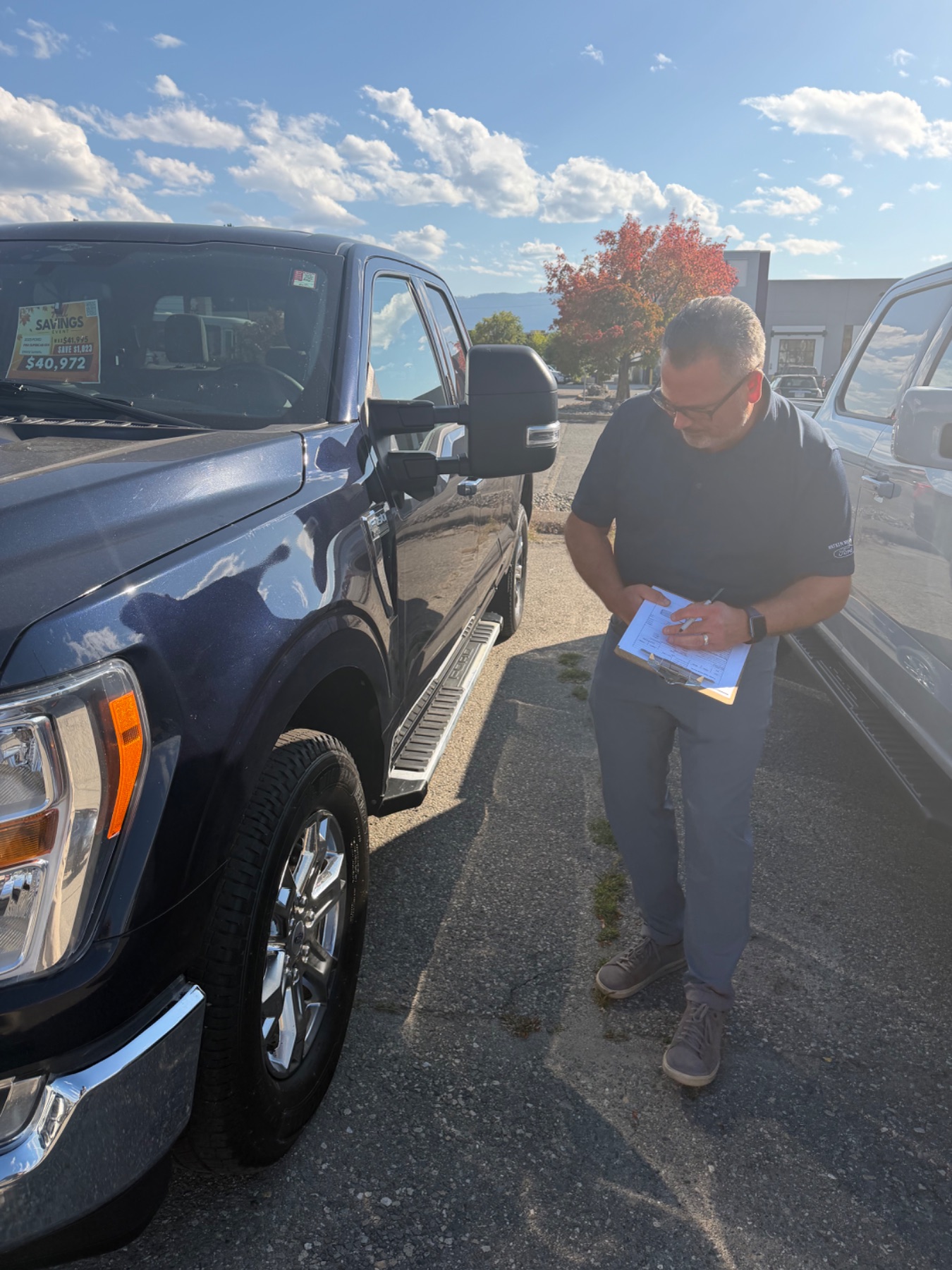
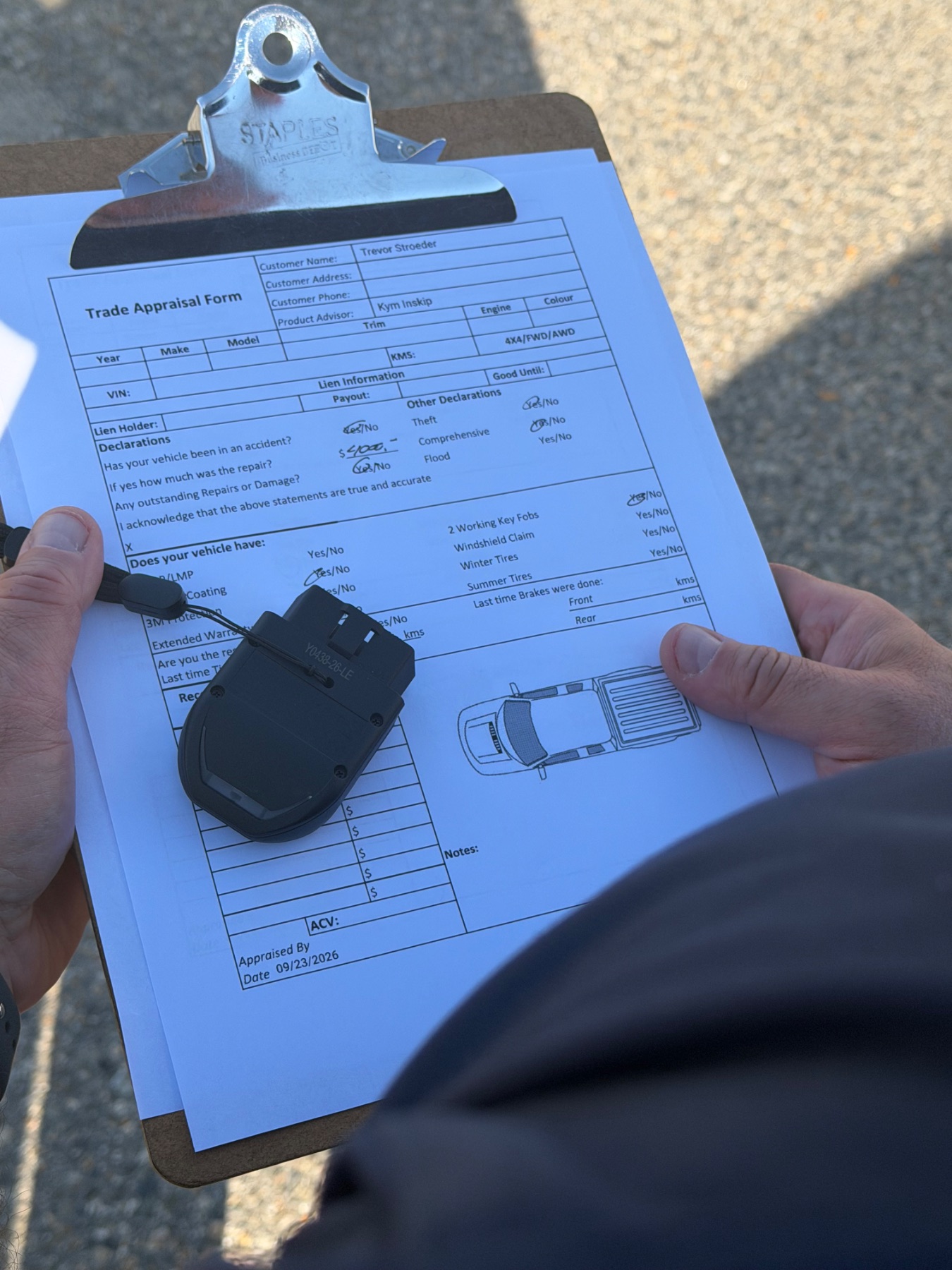
Fill in the appraisal form with your contact details and the vehicle’s year, make, model, trim and kilometres. We confirm the request within one business day. Bring the vehicle to 4602 27th Street in Vernon, where our used-vehicle team inspects it, pulls the history report and status, and gives you a written figure. Sales hours are Monday to Friday 8:00 a.m. to 5:00 p.m. and Saturday 9:00 a.m. to 4:30 p.m., or call 250-545-0611.
If you are trading up, our used cars, trucks and SUVs and new Ford inventory both show full pricing on every listing, and the trade-in comes off before tax exactly as the table above describes. If you are looking at trucks specifically, start with our used trucks for sale in Vernon.
Frequently asked questions
Do I have to buy a vehicle from Watkin Motors to sell mine?
No. We buy vehicles outright as well as taking trade-ins. The appraisal form is the same for both, and the written offer stands whether or not you buy from us.
Does a trade-in really lower the tax on my next vehicle in B.C.?
Yes. Under B.C.’s Bulletin PST 116, the trade-in value is deducted from the purchase price before PST is calculated when the trade-in is on the same sales agreement, you own the vehicle and it is registered in B.C. GST is also charged only on the difference when the owner is not a GST registrant. On a $20,000 trade-in against a vehicle under $55,000 that is $2,400 less tax. See the bulletin for the full rule.
Does the trade-in change which PST rate I pay?
No. The PST rate is based on the full price of the vehicle you are buying, before the trade-in is deducted. A $60,000 truck is taxed at the 10% rate even with a $25,000 trade-in; the 10% is then applied to the remaining $35,000. That example is from Bulletin PST 116.
Why is a private buyer in B.C. taxed on Black Book value instead of what they paid?
Since October 1, 2022, PST on a private vehicle sale in B.C. is calculated on the greater of the price paid and the Canadian Black Book average wholesale value, at 12%. The rule is set out in the Ministry of Finance’s Notice 2022-005. A buyer can only lower it with a FIN 320 appraisal showing the vehicle is worth less than the book figure.
What if I owe more on my loan than the vehicle is worth?
The shortfall is negative equity. It can be paid at the time of trade or, in some cases, financed into the next loan. The Financial Consumer Agency of Canada cautions that rolling it forward can lead to a cycle of debt. Get the payout figure from your lender first, then talk to our finance team about both options.
How many kilometres is too many?
There is no cutoff for selling a vehicle, but there are cutoffs for what a dealer can do with it. Ford Blue Advantage certification requires a Ford up to six years old with under 130,000 km (Gold) or under 160,000 km (Blue), per ford.ca. Inside those limits a vehicle can be resold with a Ford-backed service plan, which is reflected in what it is worth.
What documents do I bring to a trade-in appraisal in Vernon?
Your driver’s licence, the vehicle’s registration (APV250), both keys, any service records, and the payout letter from your lender if there is a loan. If the vehicle is registered to someone else, that person needs to be part of the sale. Check our hours before you come in.
Find out what your vehicle is worth in Vernon this week.
Free written appraisal. No obligation to buy. Trade in or sell outright.
Where these details come from. B.C. Ministry of Finance Bulletin PST 116, Motor Vehicle Dealers and Leasing Companies (revised April 2026), Bulletin PST 308, PST on Vehicles (revised August 2026) and Notice 2022-005 (revised September 2024); Canada Revenue Agency, Technical Information Bulletin B-084, Treatment of Used Goods (trade-in rule, Excise Tax Act s. 153(4)); ICBC, PST on vehicles and ICBC, Sell a used vehicle; AutoTrader Price Index, Q2 2026 (20 July 2026); DesRosiers Automotive Consultants and UCDA dealer survey, reported 3 September 2026; Canadian Black Book 2026 Market Preview (February 2026), 2025 Best Retained Value Awards (7 October 2025) and Canadian Black Book’s Trade-In Values; Ford of Canada, Ford Blue Advantage; People’s Law School on the Sale of Goods Act; Financial Consumer Agency of Canada and J.D. Power loan-term data as reported by Yahoo Finance Canada, 6 June 2026. Last checked 20 September 2026.
About the figures. Tax examples are illustrations using the published B.C. PST rates and federal GST rate as at 20 September 2026 for a non-zero-emission passenger vehicle bought by a purchaser who is not a GST registrant; they exclude fees, levies and licensing. Rates, thresholds and rules can change and different rules apply to zero-emission vehicles, leases, business purchases and vehicles brought in from outside B.C.; confirm your own situation with the B.C. Ministry of Finance or your Autoplan broker. Market figures are the cited publishers’ national and provincial averages and do not predict the value of any particular vehicle. An appraisal is an offer to purchase a specific vehicle on a specific date, based on its inspected condition and the market at that time, and is not a guarantee of future value. Watkin Motors Ford · 4602 27th Street, Vernon, BC · Dealer License #40257.